Vase or two faces? Edgar Rubin, 1915.

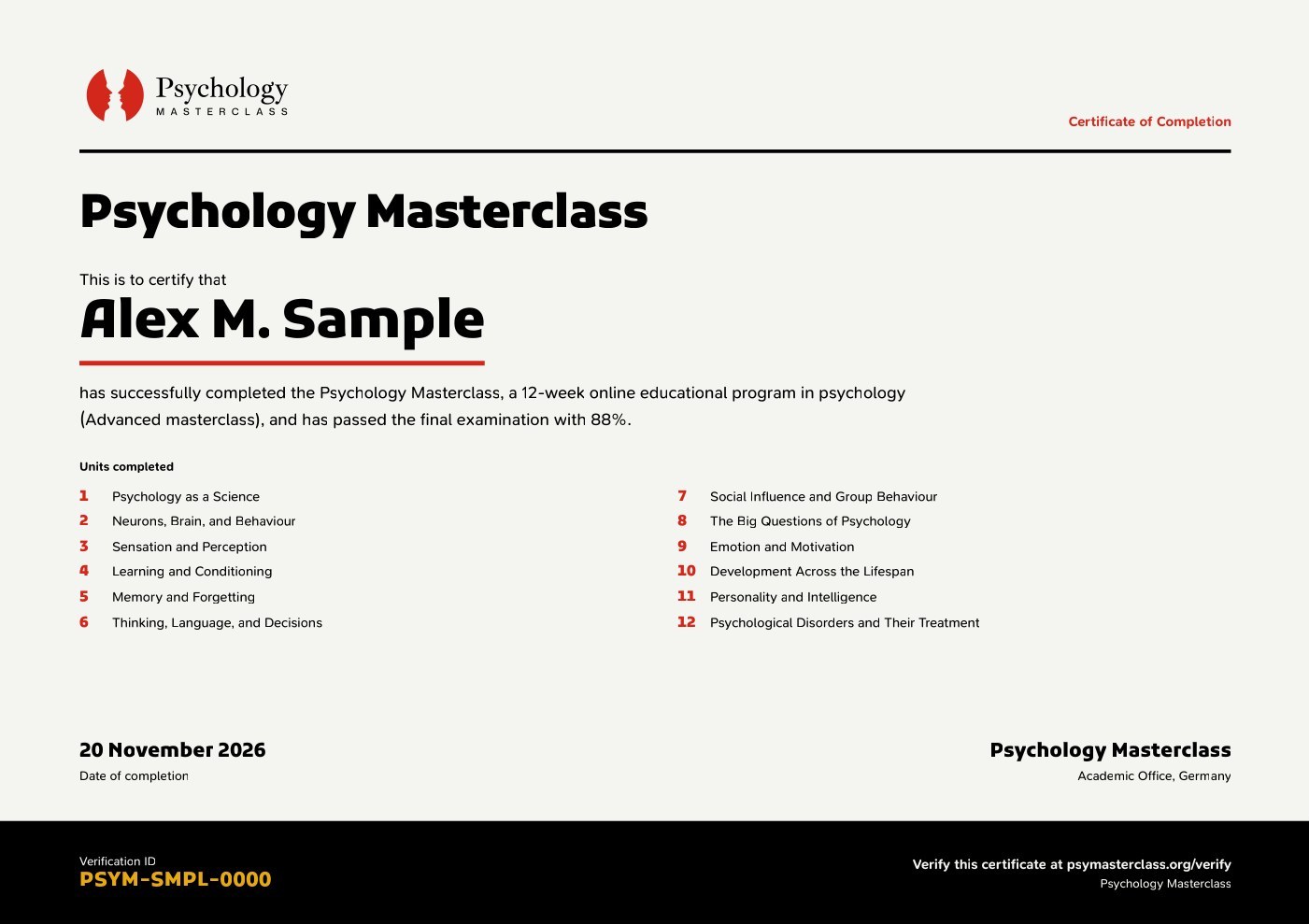
Psychology Masterclass

Twelve weeks, one unit per week: study the human mind and see the experiments behind every claim about memory, perception, and decisions.

Online Psychology Program

  • Certificate
  • Online
  • Join a community of 4500+

Our alumni study at

  • Massachusetts Institute of Technology
  • Harvard University
  • Stanford University
  • California Institute of Technology
  • Princeton University
  • University of Oxford
  • ETH Zurich
  • Imperial College London
  • University of California, Berkeley
  • University of Chicago
  • Yale University
  • Columbia University
  • Technical University of Munich
  • University of Toronto
  • University of Tokyo
  • EPFL
One drawing, two cubes: either square can be the front face. Louis Albert Necker, 1832.

Twelve weeks with the human mind

The Psychology Masterclass takes you through the science of mind and behaviour one unit at a time. You enrol, and from then on a new unit reaches you every week. Each unit is a chapter written for this program, with the original experiments, worked examples on real data, and the published research of psychologists and neuroscientists who are active today.

A quiz completes every unit and opens the next. At the end you sit a final exam and receive a certificate with a public verification page.

  • Structured. A fixed sequence of units that starts with how psychologists measure behaviour and ends with the brain science of memory and consciousness.
  • Demanding and fair. Every claim comes with the study behind it, and you learn to read its numbers: sample size, effect size, and what a p-value can tell you.
  • Recognized. A certificate and a transcript, both with a verification ID that anyone can check online.
How the program works

Who is this program for?

For high school students, university students, and lifelong learners. You do not need to have studied psychology before. Unit 1 gives every participant the same toolkit.

Equal dots, unequal gaps, and you see three groups. Max Wertheimer described grouping by proximity in 1923.

High School Students

You want to know why people think and act as they do, and you want a head start before you choose a degree. The masterclass gives you a strong base for IB Psychology, A level Psychology, and AP Psychology, and for neuroscience competitions such as the International Brain Bee.

  • No prior psychology needed
  • Certificate for university applications
  • Ideas for an Extended Essay or project

University Students

A supplement to a degree in psychology, neuroscience, medicine, or education, or a way into psychology from another subject. Use it to prepare for your own experiments, a dissertation, or a first research placement.

  • The original studies and their data
  • Current research papers every week
  • A base for a first project

Lifelong Learners

You read about the brain and behaviour and want to know which findings hold up. The masterclass takes you through psychology step by step, with the evidence for each claim and an honest account of the studies that failed to replicate.

  • No deadlines, pause any time
  • Unit 1 explains the statistics
  • Read on screen or as PDF

How does it work?

From enrolment to certificate in six steps.

The two white lines are exactly the same length. Franz Carl Müller-Lyer, 1889.
  1. Step 1: Enrol

    Create your account with your email address, choose your masterclass, and pay the Tuition Fee. Your program starts at once.

  2. Step 2: Receive your unit

    Unit 1 arrives immediately, every further unit on a Monday: as a web page and as a PDF to keep.

  3. Step 3: Study

    Work through the text, the classic experiments, and the worked cases. A day later we send further reading with current research papers.

  4. Step 4: Take a quiz for every unit

    Each unit has its own quiz: ten questions, open book, no time limit. You submit it before the next unit is sent to you.

  5. Step 5: Sit the final exam

    50 questions across all units of your masterclass in 60 minutes, open book. Pass with 70%, with up to 3 attempts.

  6. Step 6: Earn your certificate

    Certificate and transcript as PDF, each with a verification ID and a personal link you can share.

Topics

16 units in three groups. Foundation covers Units 1 to 8, Advanced continues to Unit 12, and Advanced + Cognitive Neuroscience adds Units 13 to 16.

One unit per shape, all evenly spaced. Shapes that look alike are seen as one group.
Wilhelm Wundt seated among colleagues in the Leipzig laboratory with the timing apparatus of early reaction-time experiments, printed in black and off-white.

Units 1 to 8

Mind, Brain, and Behaviour

How psychologists run experiments and read their data, how the brain works, how we perceive, learn, remember, and decide, and how other people shape what we do, with a closing unit on the big questions of the field.

  1. 1Psychology as a Science
  2. 2Neurons, Brain, and Behaviour
  3. 3Sensation and Perception
  4. 4Learning and Conditioning
  5. 5Memory and Forgetting
  6. 6Thinking, Language, and Decisions
  7. 7Social Influence and Group Behaviour
  8. 8The Big Questions of Psychology

Wundt's laboratory in Leipzig: Unknown photographer, public domain, printed as a duotone in black and Poster White.

Duchenne de Boulogne holds electrodes to the face of an elderly man to make the muscles of a smile contract; printed in red and black.

Units 9 to 12

The Whole Person

Where emotions come from and what drives us, how the mind develops in infancy, adolescence, and old age, what personality tests and intelligence tests measure, and how psychological disorders are diagnosed and treated.

  1. 9Emotion and Motivation
  2. 10Development Across the Lifespan
  3. 11Personality and Intelligence
  4. 12Psychological Disorders and Their Treatment

Mécanisme de la physionomie humaine, plate: Guillaume-Benjamin Duchenne, 1862, public domain, printed as a red duotone.

Full curriculum

Research presented in the program

Every unit contains a research spotlight: the published work of a psychologist or neuroscientist, explained at your level and linked to the original paper.

Grey spots flicker where the light streets cross and vanish where you look straight at them. Ludimar Hermann, 1870.

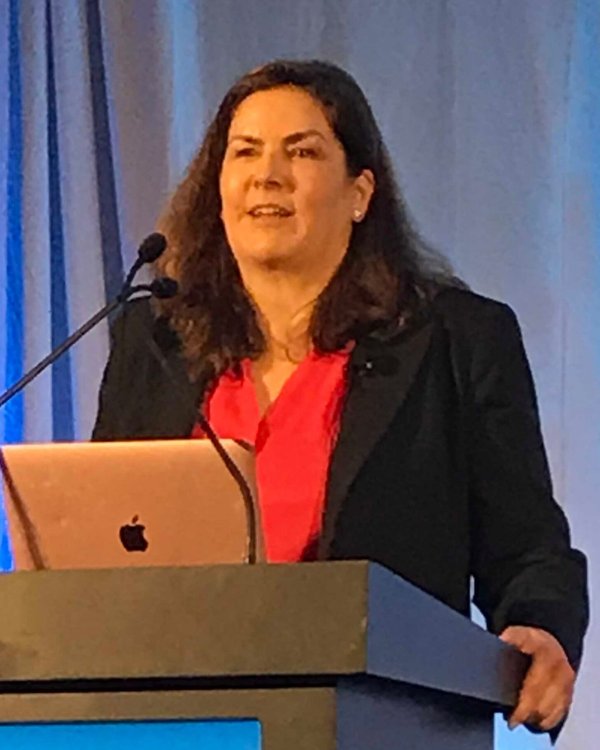
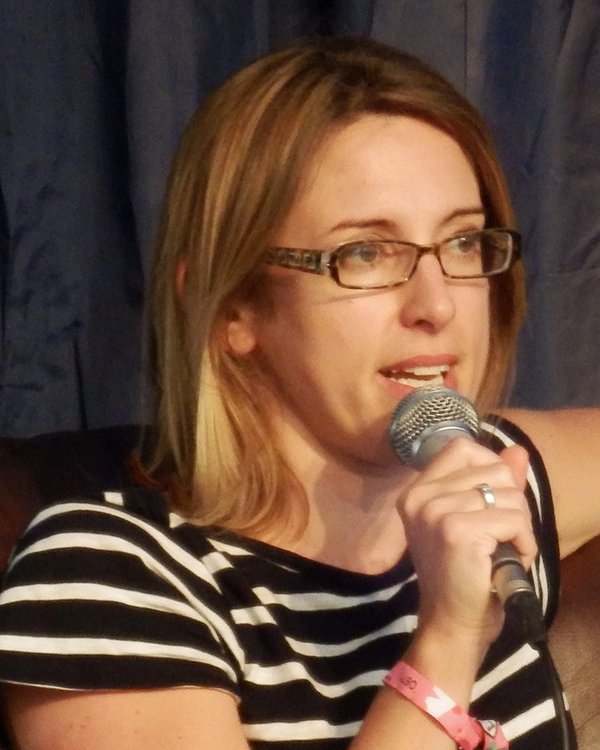
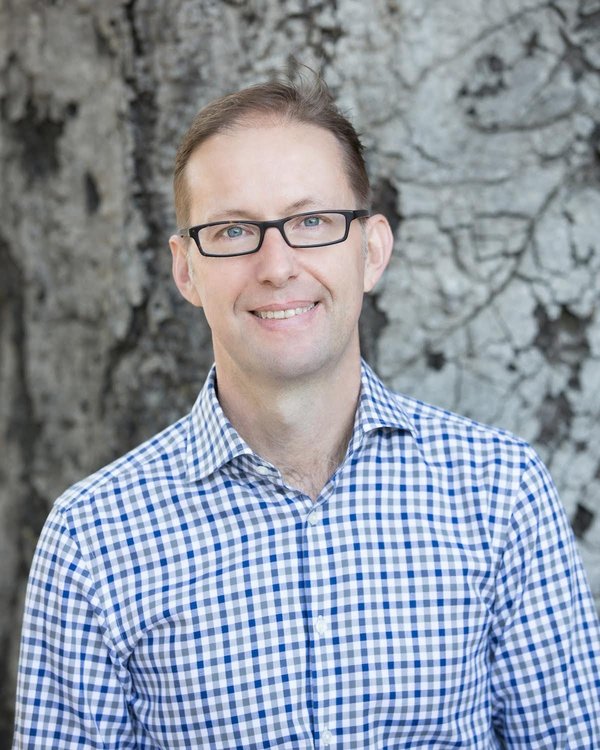
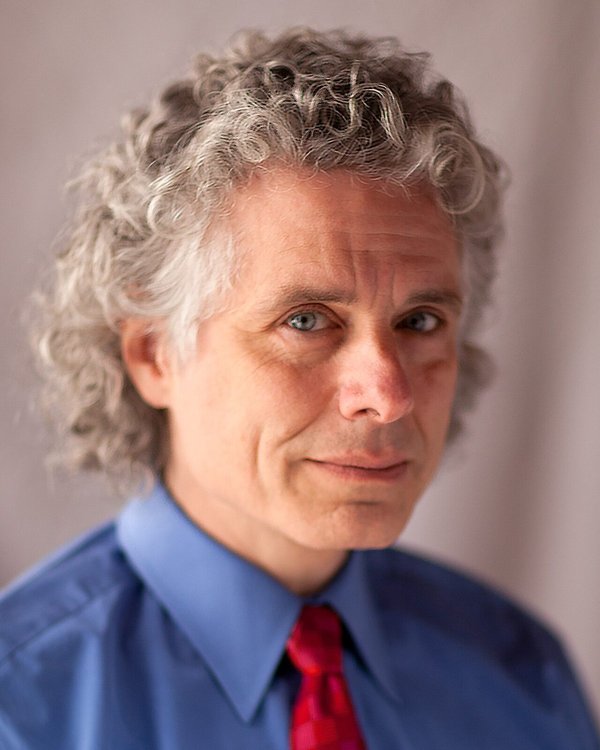
The scientists named here are not contributors to the Psychology Masterclass, are not affiliated with it, and have not endorsed it. The program presents and explains their published research, with references to the original papers.

All research spotlights

Tuition Fee

Choose the masterclass that fits you best. One Tuition Fee, paid once, covers all units, quizzes, the final exam, and your certificate.

Both ochre discs have the same radius. The circles around them change how large they look. Described by Hermann Ebbinghaus, made widely known by Edward Titchener in 1901.
8 weeks

Foundation

The fundamentals of psychology: methods, the brain, perception, learning, memory, thinking, and social influence.

Tuition Fee$35$39
Enrol in Foundation
  • 8 weekly units as web page and PDF
  • Quiz and further reading for every unit
  • Final exam, certificate, and transcript
Topics in this program
  1. 01
    Psychology as a Science
  2. 02
    Neurons, Brain, and Behaviour
  3. 03
    Sensation and Perception
  4. 04
    Learning and Conditioning
  5. 05
    Memory and Forgetting
  6. 06
    Thinking, Language, and Decisions
  7. 07
    Social Influence and Group Behaviour
  8. 08
    The Big Questions of Psychology
  9. 09
    Emotion and Motivation
  10. 10
    Development Across the Lifespan
  11. 11
    Personality and Intelligence
  12. 12
    Psychological Disorders and Their Treatment
  13. 13
    NeuroscienceBrain Imaging and Stimulation
  14. 14
    NeuroscienceMemory in the Brain
  15. 15
    NeuroscienceThe Predictive Brain
  16. 16
    NeuroscienceConsciousness and the Brain
16 weeks

Advanced + Cognitive Neuroscience

The full program plus four units on cognitive neuroscience: brain imaging, memory in the brain, prediction, and consciousness.

Tuition Fee$85$119
Enrol in Advanced + Cognitive Neuroscience
  • 16 weekly units as web page and PDF
  • Quiz and further reading for every unit
  • Final exam, certificate, and transcript
Topics in this program
  1. 01
    Psychology as a Science
  2. 02
    Neurons, Brain, and Behaviour
  3. 03
    Sensation and Perception
  4. 04
    Learning and Conditioning
  5. 05
    Memory and Forgetting
  6. 06
    Thinking, Language, and Decisions
  7. 07
    Social Influence and Group Behaviour
  8. 08
    The Big Questions of Psychology
  9. 09
    Emotion and Motivation
  10. 10
    Development Across the Lifespan
  11. 11
    Personality and Intelligence
  12. 12
    Psychological Disorders and Their Treatment
  13. 13
    NeuroscienceBrain Imaging and Stimulation
  14. 14
    NeuroscienceMemory in the Brain
  15. 15
    NeuroscienceThe Predictive Brain
  16. 16
    NeuroscienceConsciousness and the Brain

Tuition Fees are one-time payments and include applicable taxes. Secure payment by card through Stripe, in US dollars, converted into your currency by your bank. Financial Aid

Four notched discs, and the eye draws the frame of the certificate. Gaetano Kanizsa, 1955.

Your certificate

Participants who pass the final exam receive an official certificate of completion. It states your name, the masterclass, its duration, and the units you completed.

  • Certificate and transcript. The transcript lists your score in every unit quiz and in the final exam.
  • Verifiable. Both documents carry a verification ID that can be checked on this website.
  • Shareable. Your personal verification link shows your result to universities, scholarship committees, and employers.
Unit 3 Sensation and Perception The world never reaches the brain; only the nerve signals set off by its receptor cells do. This unit measures how small a difference a person can notice, separates what a person can sense from what they are willing to report, follows light from the retina to the cortex, and uses the classic illusions, the cross-cultural data, and the dress photograph of 2015 to show that perception is a well-informed inference rather than a copy of the image.
  • Explain transduction, thresholds, and Weber's law with numbers
  • Separate sensitivity from the criterion with signal detection theory
  • Follow the visual pathway from the retina to the two cortical streams
  • Use the Gestalt principles, depth cues, and size constancy to explain illusions
1 of 18

Sample unit

Read one complete unit before you enrol, exactly as participants receive it: the full text with its classic experiments, worked cases, figures, and research spotlight.

Unit 3, 18 pages

Sensation and Perception

The world never reaches the brain; only the nerve signals set off by its receptor cells do. This unit measures how small a difference a person can notice, separates what a person can sense from what they are willing to report, follows light from the retina to the cortex, and uses the classic illusions, the cross-cultural data, and the dress photograph of 2015 to show that perception is a well-informed inference rather than a copy of the image.

The unit opens with these questions

  1. Why do the two lines of the Müller-Lyer figure look different in length when a ruler shows they are equal?
  2. What is a just noticeable difference, and why does Weber's law say that it grows with the size of the stimulus?
  3. Why do I never notice the blind spot in each eye, although it is wide enough to hide about 10 full Moons placed side by side?
  4. How does the brain judge the size of an object whose image on the retina shrinks as it moves away?
  5. What does it mean to say that perception is an inference, and what evidence supports that view?
  6. How does signal detection theory separate what I can sense from what I am willing to say?
The two red bars are the same length; the upper one looks longer. Mario Ponzo, 1911. One of the opening questions of the unit is about this figure.

Academic community

Masterclass participants come from all over the world, and when you complete the program you stay part of a network that keeps you close to psychology.

The long lines are parallel. The short strokes make them seem to lean. Johann Karl Friedrich Zöllner, 1860.
Psychology academics in our community
4500+
Countries represented
90+
Schools and universities represented
750+

Psych-Connect

Our alumni program introduces former participants to one another across countries: for study advice, exchange about university applications, and shared projects.

Opportunities

Past participants hear from us about scholarships, competitions, summer schools, and other academic opportunities in psychology and neuroscience.

A place in science

The program shows you how research on the mind is done and where it happens, so that your next step at school, at university, or beyond is an informed one.

The academic community

Frequently asked questions

Stairs seen from above, or from below? Heinrich Schröder, 1858.
Who is this program for?

For high school students, university students, and lifelong learners. High school students use it to get ahead in psychology before a degree, next to IB, A level, or AP Psychology, and to prepare for the International Brain Bee. University students in psychology, neuroscience, medicine, education, or another subject take it next to their degree, before a first research project or a dissertation. Lifelong learners use it to find out which of the findings they have read about hold up. The Foundation masterclass suits a first contact with the subject; the Advanced masterclass goes on to emotion, development, personality and intelligence, and psychological disorders and their treatment.

What do I need to know before I start?

School mathematics is enough: percentages, fractions, square roots, simple algebra, and reading a graph. You do not need to have studied psychology, biology, or statistics. Unit 1 teaches every statistical tool the later units use, from the mean and the standard deviation to correlation, effect sizes, and the p-value, and Unit 2 introduces the neuron and the brain from the beginning. Every calculation in a later unit is shown step by step, and no unit uses calculus.

How much time do I need each week, and are there live sessions?

Most participants spend three to five hours a week: two or three hours on the unit, under an hour on the open-book quiz, and the rest on the further reading if they want it. The program is fully online and has no live sessions, so it works in every time zone and next to school, university, or work. You receive the units by email and read them on the website or as PDF. Quizzes and the final exam are taken on the website.

Can I finish the program in less than 12 weeks?

Yes. A new unit is scheduled for every Monday, but once you have submitted the quiz of a unit you can ask for the next one ahead of schedule, from your dashboard or from the email we send you. The earliest moment is 24 hours after the previous unit was sent. We recommend the weekly rhythm, because the material needs time to settle (Unit 5 explains why spacing works), but the pace is your decision.

What happens if I fall behind or have to pause?

Nothing is lost. The next unit is only sent once you have submitted the quiz of the current one, so the program waits for you. You can pause for a week or for a term and continue at any time. There is no penalty and no deadline.

How does the final exam work?

After the last unit you sit the final exam online: 50 multiple-choice questions across all units of your masterclass, drawn individually for each participant, with a time limit of 60 minutes. It is open book. You pass with 70% correct answers. If you do not pass, you can try again after 3 days with new questions, up to 3 attempts in total.

All questions

Stay up to date

New program dates, offers, and the occasional article about the mind and the experiments that study it. You can unsubscribe at any time.

Begin your 12 weeks with the human mind