

Memory and Forgetting
This unit follows a piece of information from the senses into long-term memory and measures what happens to it on the way. It works through Sperling's flash of letters, the four chunks of working memory, the patient who could learn a skill but not remember practising it, Ebbinghaus's forgetting curve from his own data, and the experiments that show why testing yourself beats rereading. It ends with the evidence that every act of recall rebuilds a memory, from a single word that changed what witnesses saw to a wrongful conviction built on a confident identification.
Everything you know, you remember. The route to your front door, the meaning of the word “door”, the way your hand turns the key, and what happened the last time you forgot the key: all of this is memory, and it is of several kinds that can be lost separately, as one patient taught the field in 1953. This unit follows a piece of information from the senses into long-term memory, measures how much of it is lost and how fast, shows which ways of studying slow the loss, and ends with the least comfortable finding of the field, which is that every act of remembering rebuilds the memory and can change it.
1 Three stages and a map
Psychologists divide memory into three stages. Encoding is the transformation of an experience into a form that can be stored, storage is the keeping of that record over time, and retrieval is the recovery of the record when it is needed. A failure at any one of the three looks the same from outside, since the person cannot produce the information, but the causes differ. A name you never caught at a party was not encoded; a name you knew last year and cannot find today was stored and is failing at retrieval, and the relief you feel when somebody says its first syllable shows that it was there all along.
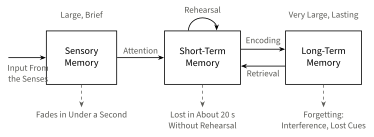
The map that organized the field for half a century is the multi-store model of Richard Atkinson and Richard Shiffrin, published in 1968 and drawn in Figure 1. Information from the senses enters a sensory memory that holds a great deal for a fraction of a second. What is attended to passes into a short-term memory of small capacity, where it survives for a matter of seconds unless it is rehearsed, that is, repeated silently to oneself, and from there some of it is encoded into a long-term memory of very large capacity, from which it is retrieved back into short-term memory when needed. Each part of the map rests on experiments, and the next two sections go through them. The model also has known problems. Material does not enter long-term memory merely because it was held in short-term memory for a long time, as Section 3 shows, and short-term memory is not a single gateway, since there are patients with a short-term memory of one or two digits who still form normal long-term memories. The map is kept because it names the right questions.
1.1 Sensory memory
For a fraction of a second after a glimpse, more is available than a person can report. George Sperling showed this in 1960 with a small change of instruction. He flashed arrays of letters, for example three rows of four, for 50 milliseconds, which is a twentieth of a second. Asked to write down everything, a procedure called whole report, his five observers managed about 4.3 letters on average, whatever the size of the array. Sperling then played a tone at, or just after, the moment of the flash. The tone was high, middle, or low in pitch, and it told the observer to report only the top, middle, or bottom row. The observer could not know in advance which row would be asked for, so the proportion of that row he got right estimates the proportion of the whole array that was still available. This method is called partial report. The brief, high-capacity store that the method reveals is called iconic memory for vision, and its counterpart for hearing, which lasts a few seconds, is echoic memory.
In his fourth experiment, with 12 letters in three rows of four, the observers reported 82% of the cued row correctly when the tone came 50 ms before the flash, too short a lead for the eyes to reach the cued row before the letters had gone. The cued row is a random sample of the array, so the same share of the whole array was available, which is \(0.82 \times 12 = 9.8\) letters, more than twice the 4.3 of a whole report. With the tone delayed by one second, accuracy fell to 38%, which is \(0.38 \times 12 = 4.6\) letters, the same as the whole report. What the observers wrote down in a whole report was the part of the fading image, the icon that gives iconic memory its name, that they had managed to move into short-term memory before it faded.