 Image: Janet Stephens, public domain, via Wikimedia Commons
Grid cells and the brain's map
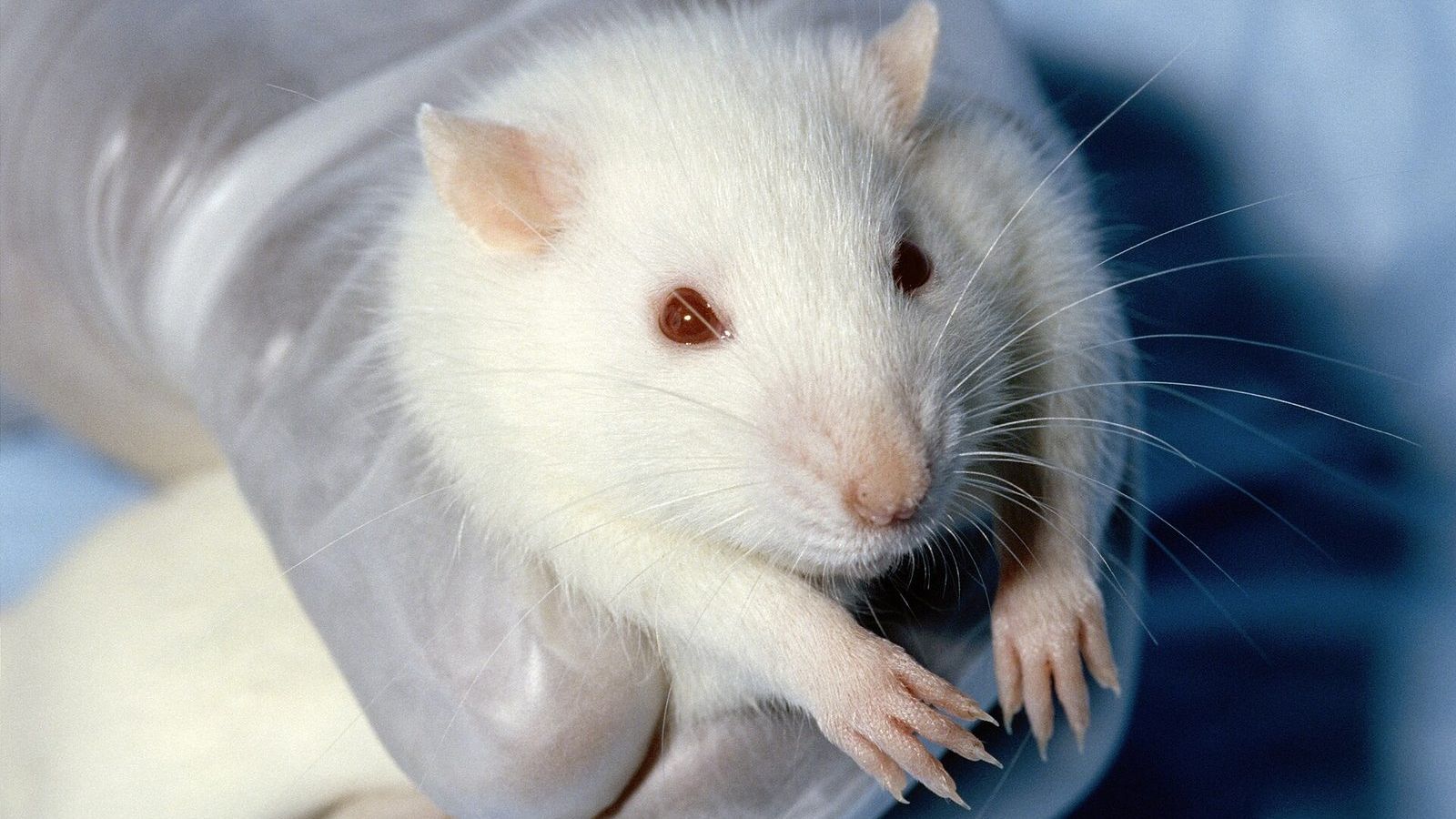
In 1948 Edward Tolman argued, from the behaviour of rats in mazes, that the animals were building a map rather than learning chains of turns, which he called a cognitive map, and using it to take shortcuts. Behaviourists found the idea unscientific, because a map in a rat's head could not be observed. It took 23 years and a microelectrode to observe it.
Place cells
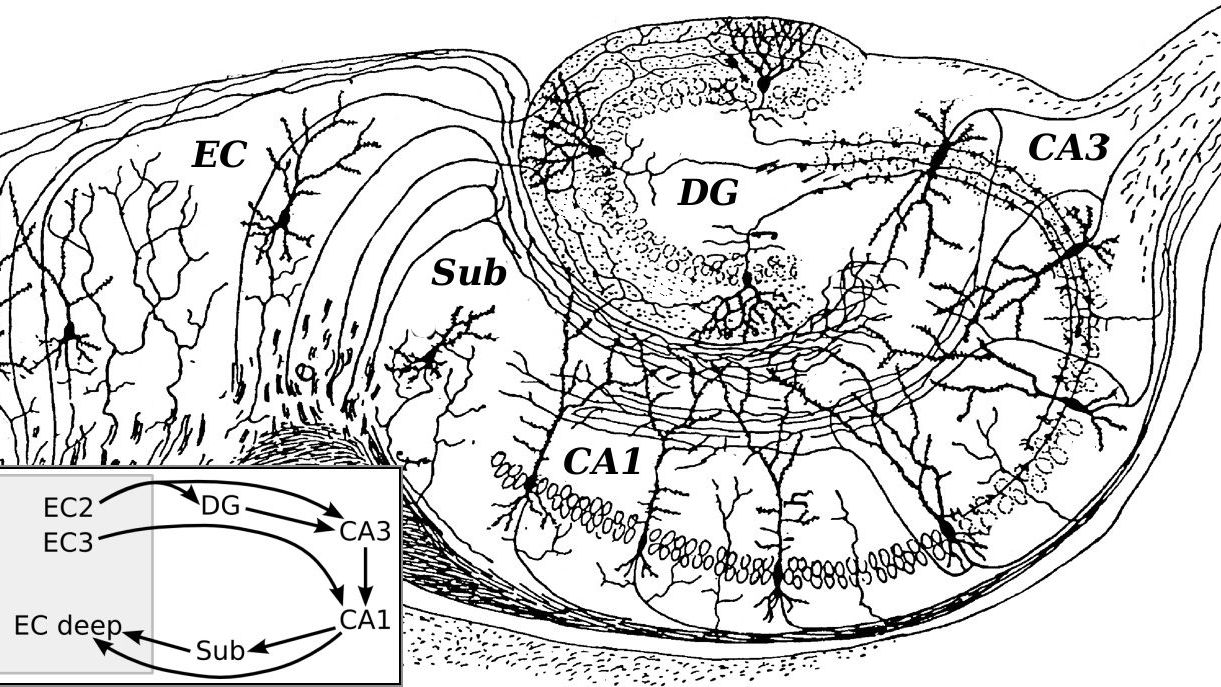
In 1971 John O'Keefe and Jonathan Dostrovsky at University College London recorded from single neurons in the hippocampus of rats that were free to move about a platform. Some of the cells fired only when the rat was in one particular part of the platform, and were silent everywhere else. Each such cell had its own place, and a few dozen of them covered the whole space. The short report in Brain Research, at the journal, called them place cells, and in 1978 O'Keefe and Lynn Nadel argued in a book called The Hippocampus as a Cognitive Map that Tolman's map had been found and that it lived in the structure Henry Molaison had lost. The place fields are not fixed to the senses: they stay stable in the dark, they rearrange when the rat is put in a new room, and they can be driven by the animal's own movement when the landmarks are removed.
A map needs more than places. It needs a direction, which was found in 1990 in cells of the thalamus and related structures that fire whenever the animal's head points one way, like a compass. And it needs a metric, a way of knowing how far one place is from another. That took until 2005.
Grid cells
May-Britt and Edvard Moser, who had trained with O'Keefe, set up a laboratory in Trondheim and recorded one synapse upstream of the hippocampus, in the medial entorhinal cortex, from which the hippocampus gets most of its cortical input. Torkel Hafting, Marianne Fyhn, and Sturla Molden, working with them, found cells that fired at many places rather than one, and when the places were plotted on the floor of a large box they formed a lattice of equilateral triangles: a hexagonal grid, as regular as a honeycomb, extending across the whole space. The paper, "Microstructure of a spatial map in the entorhinal cortex", appeared in Nature in 2005 and is at the journal.
Each grid cell has its own grid, and neighbouring cells have grids of the same spacing and orientation, shifted relative to each other so that between them they tile the space. The spacing grows in steps from about 30 cm at the top of the structure to several metres lower down, in a small number of separate modules, which gives the animal a set of rulers at different scales. The grids persist in darkness and in new environments, which suggests that they are generated inside the brain from the animal's own motion and anchored to landmarks afterwards. Together, place cells, head direction cells, grid cells, and border cells, which fire along the walls, make up a positioning system, and the 2014 Nobel Prize in Physiology or Medicine went to O'Keefe and the Mosers for it; the summary at nobelprize.org is a good short account.
The same cells in people
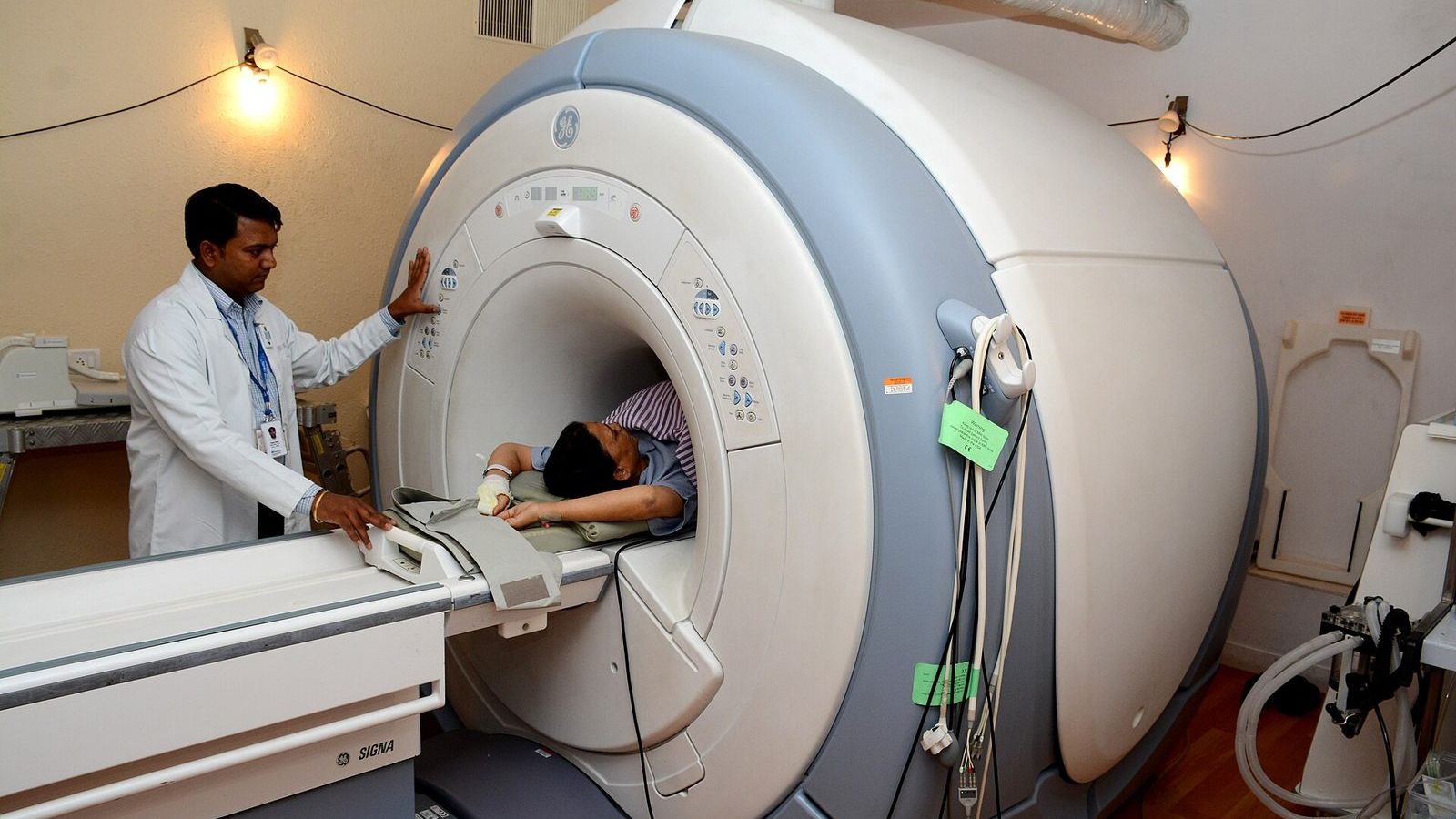
Grid cells cannot be recorded in healthy humans, but their signature can. Christian Doeller, Caswell Barry, and Neil Burgess reasoned in 2010 that if a population of grid cells with a common orientation underlies navigation, then the fMRI signal from the entorhinal region should vary with the direction a person moves in a virtual environment, with a six-fold symmetry, strongest along the grid axes. It did, in the entorhinal cortex and in a few connected regions, and the paper is at Nature. Grid cells themselves were later recorded in epilepsy patients who had electrodes implanted for clinical reasons. The entorhinal cortex is also the first region damaged in Alzheimer's disease, and getting lost is among the first symptoms; a study in 2015 found a weaker grid-like signal in young carriers of the main genetic risk variant, decades before any symptoms.
The map may not be only for space. In 2016 Alexandra Constantinescu, Jill O'Reilly, and Timothy Behrens had people learn a two-dimensional space of bird shapes, defined by neck and leg length, and found the same six-fold signal when the people moved through that abstract space. The suggestion, still being tested, is that the grid is the brain's general method for laying a coordinate system over anything that has dimensions, including concepts, and that the cognitive map is a map in a wider sense than Tolman meant.
The torus
The question that the single-cell recordings could not answer was what the population does as a whole. In 2022 Richard Gardner and colleagues in the Mosers' laboratory used Neuropixels probes, silicon needles with hundreds of recording sites, to record from up to several hundred grid cells of one module at once, and asked, with a method from topology that makes no assumption about the answer, what shape the joint activity traces out. The answer was a torus, the surface of a doughnut. Every state of the population lies on that surface; as the rat moves, the point moves around the torus, and the two directions around the ring correspond to the two axes of the grid. The shape was the same in a box, on a track, and in sleep, when the animal was not moving at all. The paper, "Toroidal topology of population activity in grid cells", is at Nature and is the research spotlight of Unit 14 of the masterclass.
The result matters because it settles a question about mechanism. A torus is what the theory of continuous attractor networks had predicted since the 1990s: a population whose connections hold its activity on a closed surface, moved along it by the animal's velocity, so that the position of the bump on the surface is the animal's position on the grid. The recording showed that grid cells are a network with a shape, and that the shape is kept during sleep, which is the state in which memories are thought to be replayed and consolidated.
From a rat in a box to a question about the mind
The science of the cognitive map began with a rat that took a shortcut and a theorist who said the rat must have a map. It has produced a positioning system with known parts, a Nobel Prize, a signal that can be read in human brain scans, a shape in a population of neurons, and a hypothesis that the same machinery organizes knowledge that has nothing to do with space. Each step was a recording that someone thought could not be made. The hippocampus that Henry Molaison lost in 1953, which cost him his memory for events, is the structure that places those events on the map, and the two lines of research have been converging for fifty years.