 Image: Slashme, Patrick J. Lynch, and Fvasconcellos, CC BY-SA 4.0, via Wikimedia Commons
What dopamine actually does
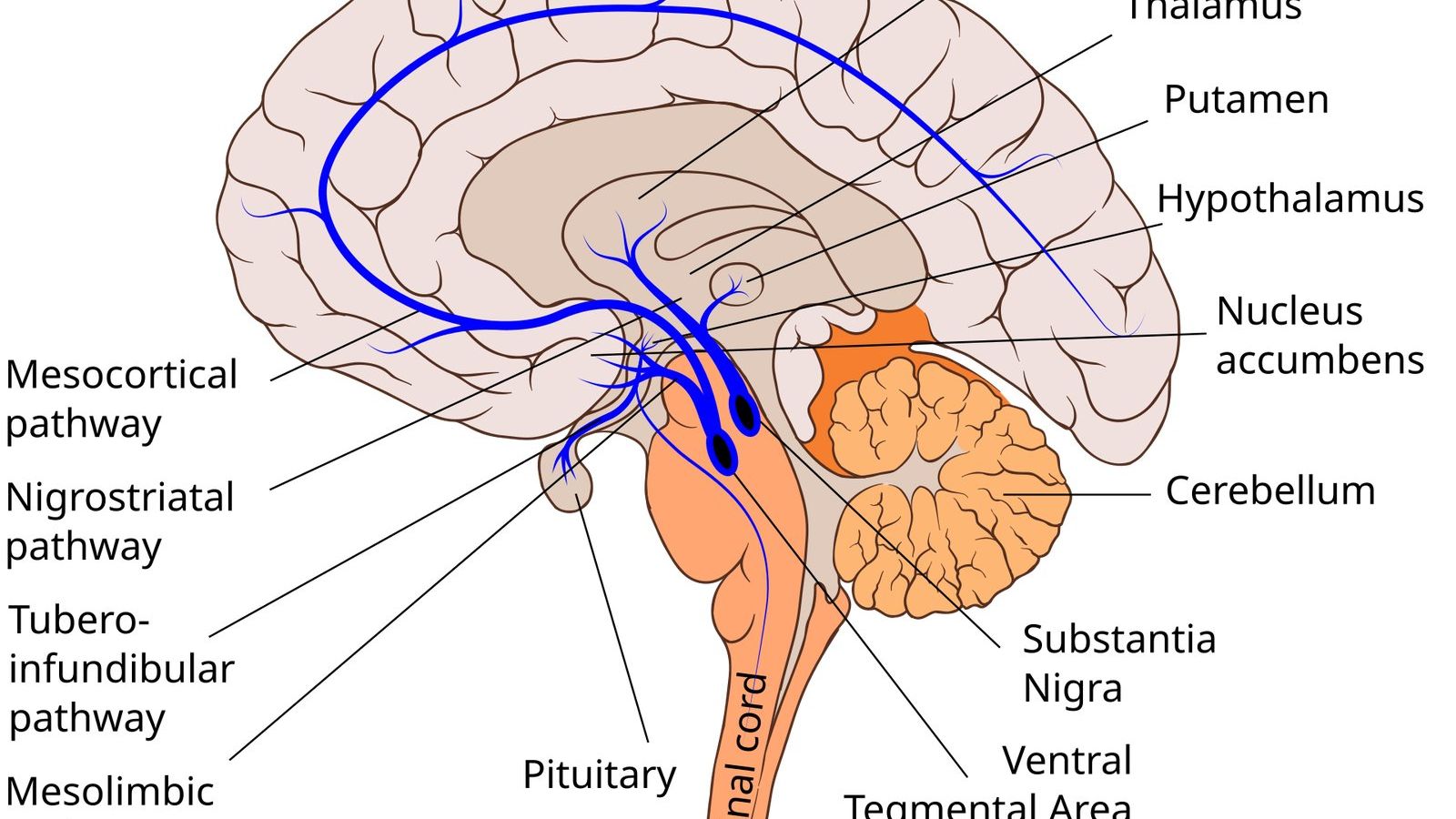
About half a million neurons in the human midbrain, in two clusters called the substantia nigra and the ventral tegmental area, make dopamine and send it along long axons to the striatum, the prefrontal cortex, and a few other places. Half a million is a very small number in a brain of 86 billion, and the neurons are among the most discussed in neuroscience, because their loss causes Parkinson's disease, because every addictive drug raises the dopamine they release, and because they are supposed to be the source of pleasure. The last claim is the one this article is about, and it has been known to be wrong since the 1990s.
The monkeys and the juice
Wolfram Schultz, working in Fribourg and later in Cambridge, recorded from single dopamine neurons in monkeys while the animals learnt simple tasks. The first finding fitted the pleasure story: when a drop of juice arrived unexpectedly, the neurons fired a brief burst. The second did not. Once the monkey had learnt that a light came on a second before the juice, the burst moved. The neurons now fired at the light and did nothing at the juice. And if the light came on and the juice did not, the neurons paused at the moment the juice should have arrived, dropping below their resting rate.
The pattern makes no sense for a pleasure signal. The juice is as sweet on the hundredth trial as on the first, and the neurons have stopped responding to it. It makes complete sense for a signal that reports the reward prediction error: the difference between the reward received and the reward expected. An unexpected juice is a positive error, and the neurons fire. A predicted juice is zero error, and they are silent. A predicted juice that fails to arrive is a negative error, and they pause. The light, once learnt, is itself better news than expected at the moment it appears, so the error moves to it. Schultz, Peter Dayan, and Read Montague set this out in Science in 1997 in "A Neural Substrate of Prediction and Reward", at the journal, and showed that the firing matched, almost line for line, an algorithm from machine learning called temporal difference learning, which had been designed to learn predictions from exactly such errors.
What the error is for
A prediction error is a teaching signal. If the world was better than you expected, whatever you just did or saw should be valued more next time; if it was worse, less; if it was as expected, nothing needs to change. The Rescorla-Wagner rule of 1972, which Unit 4 of the masterclass works through, learns associations from an error of exactly this kind, and the dopamine signal looks like the brain's implementation of it. Drugs of abuse, which raise dopamine directly, produce a prediction error that never goes to zero because it is not computed from any prediction, and the account explains why the cues around drug taking acquire such force. It also explains why dopamine neurons respond to novelty and to surprising events that are not rewards at all, which a pleasure signal should not do, and why the response scales with how uncertain the reward was.
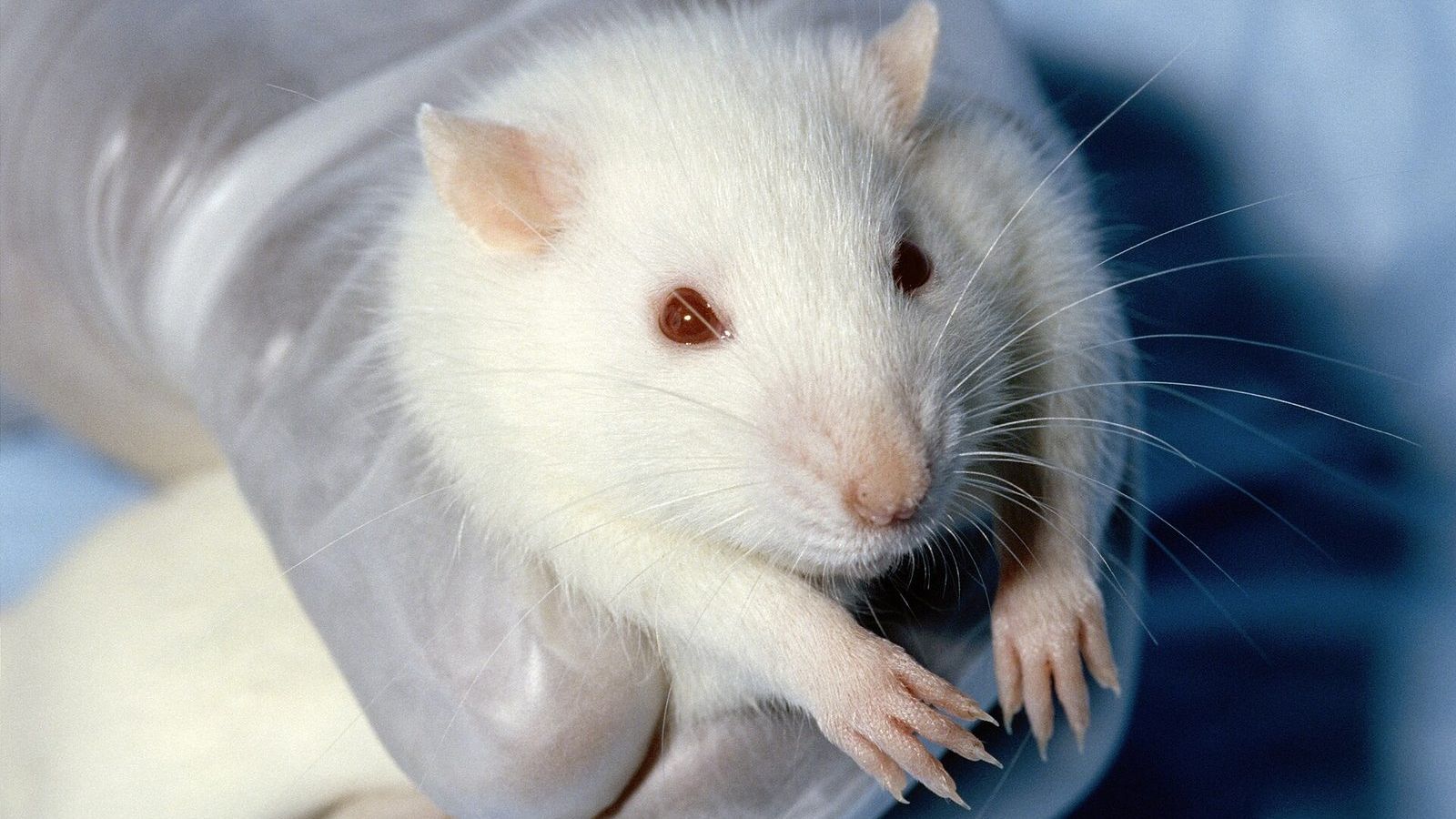
The strongest evidence that the signal teaches, rather than merely reporting, came from optogenetics. In 2013 Elizabeth Steinberg and colleagues used light to drive dopamine neurons in rats at the moment an expected reward arrived, artificially creating a positive error where there should have been none, and the rats learnt an association that the normal design makes impossible to learn. Schultz's own review of two decades of the work appeared in Nature Reviews Neuroscience in 2016 and is free at PubMed Central; it is the research spotlight of Unit 15, which runs the temporal difference rule by hand.
Wanting and liking
A second line of evidence separates dopamine from pleasure in a different way. Kent Berridge and Terry Robinson at the University of Michigan asked what happens to pleasure when dopamine is removed. Rats whose dopamine neurons had been destroyed with a toxin stopped eating and would starve among food unless fed by tube. But when sugar was placed in their mouths they made the same tongue-protruding, lip-licking faces that normal rats and human infants make to sweetness, and the same grimaces to bitterness. They still liked sugar. They had stopped wanting it. Conversely, raising dopamine makes rats work harder for sugar and does nothing to the faces.
Berridge and Robinson's conclusion, developed since 1993, is that wanting and liking are different systems. Dopamine drives wanting, the motivational pull towards a reward and its cues. Liking, the hedonic reaction itself, depends on small opioid and cannabinoid hotspots in the nucleus accumbens and elsewhere, and dopamine is not needed for it. The two usually go together, which is why the confusion was possible, and they come apart in addiction, where cues for the drug produce intense wanting long after the drug has stopped producing much pleasure. Their account is set out in a 2016 review in the American Psychologist, at the journal.
Two accounts or one
The prediction-error view and the wanting view are often presented as rivals, and the people who hold them have argued in print, but they are closer than they look. Both say that dopamine is about the expectation of reward rather than its enjoyment. The prediction-error view describes the fast, phasic bursts that teach; the wanting view describes a slower, tonic level that sets how much effort an animal will spend for what it has already learnt to expect. Recordings now show both kinds of signal, sometimes in the same neurons, and the current picture is that dopamine carries several messages on different timescales, none of which is pleasure.
What follows for the rest of us
The popular account has consequences, because people act on it. "Dopamine detox", the idea that abstaining from pleasant things resets a pleasure chemical, has no basis in the physiology; dopamine levels are not depleted by enjoyment and are not restored by boredom. The claim that a phone notification gives a hit of dopamine is closer to right than its critics allow, but what the hit does is make the next notification more wanted, which is a better description of what a phone does to a person than any talk of pleasure. And the finding that the signal moves from the reward to its cue is the reason that the goal itself, once reached, often disappoints: the dopamine was spent on the anticipation, as the neurons' silence at the juice predicted. The masterclass gives the physiology in Unit 9 and the learning rule in Unit 15, and after both the phrase "pleasure chemical" should be hard to read without wincing.