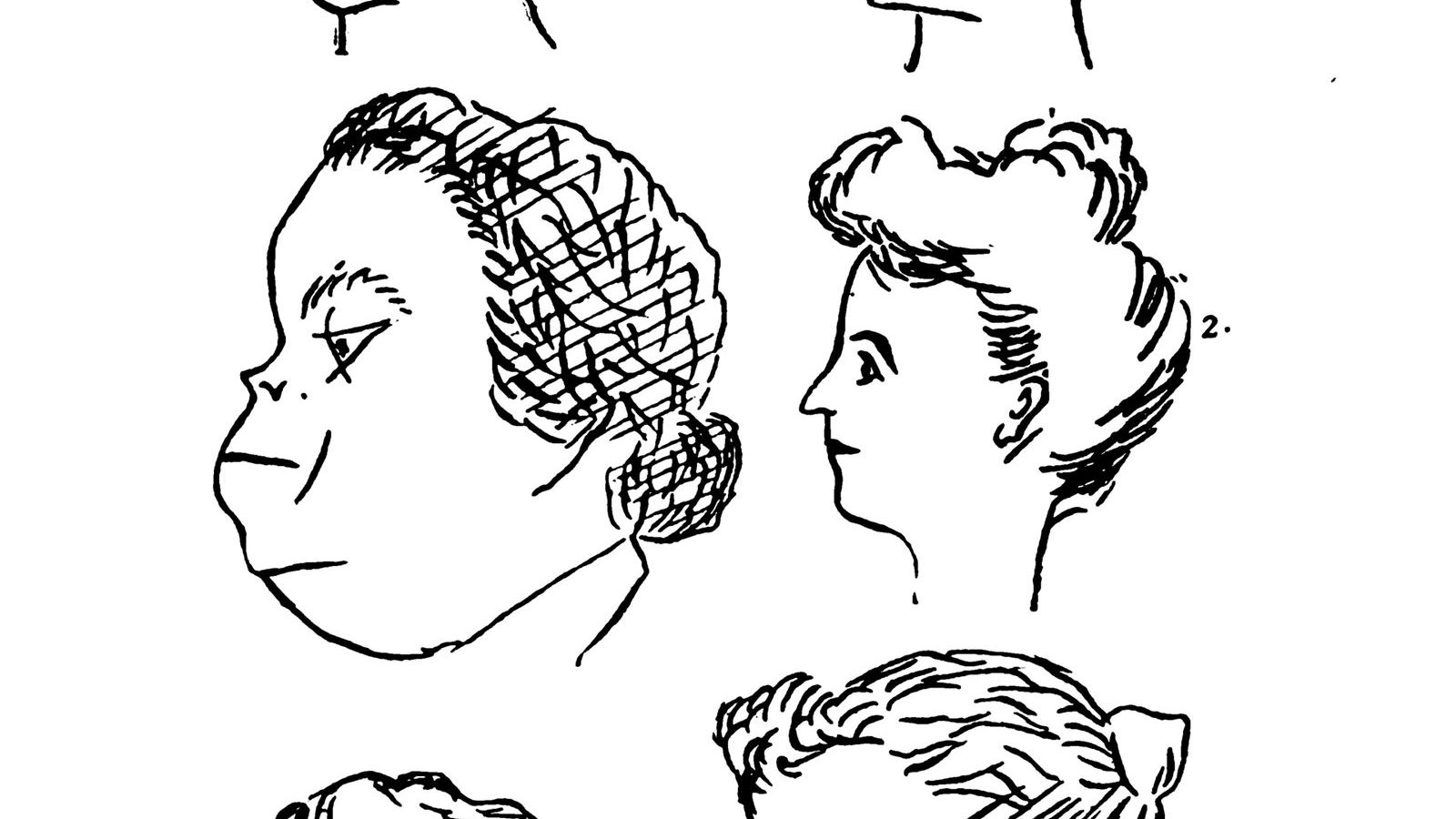
 Image: Mary Mark Ockerbloom, CC BY-SA 4.0, via Wikimedia Commons
How a child learns the past tense
Jean Berko Gleason showed children a drawing of a bird-like creature in 1958 and said: "This is a wug. Now there is another one. There are two of them. There are two ..." Four-year-olds said "wugs". Shown a man doing something called ricking, and asked what he did yesterday, they said "ricked". They could not have heard either word before, so they were not repeating. They had a rule. The paper, "The Child's Learning of English Morphology", is at the journal, and the wug has been the mascot of child language ever since.
The rule has a cost, and the cost is the subject of this article. English has about 180 irregular verbs, most of them common: go, come, see, eat, run, sing, bring, break. A child who has learnt that the past tense is made by adding -ed will apply it where it does not belong, and does: "goed", "comed", "eated", "breaked", "bringed". The errors are called overregularization, and they are among the clearest evidence that the child is building a grammar rather than copying one.
The shape of the curve
The timing is the strange part. Children do not start with "goed" and learn "went" later. They start with "went", correctly, because they have heard it hundreds of times and stored it as a word. Then, somewhere between two and a half and three and a half, when they have worked out the -ed pattern from the regular verbs, "goed" appears, alongside "went" and sometimes in the same sentence. Over the following years "went" wins. Plotted against age, the correct use of an irregular verb goes down and then up, which is called a U-shaped curve, and it is one of the few places in development where a child gets worse at something because they have learnt something.
The size of the dip was measured by Gary Marcus, Steven Pinker, and colleagues in 1992, from transcripts of 83 children recorded over years. The result surprised everyone who had taught the topic: overregularization errors were rare, about 2.5% of the occasions on which a child used an irregular past tense, with wide variation between children and higher rates for the rarer verbs. The famous "goed" stage, in which the child supposedly abandons the irregulars altogether, does not exist in the recordings. The child says "went" 40 times for each "goed". The U is shallow. It is also real, and the question is what produces it.
Words and rules
Pinker's account, set out at book length in Words and Rules in 1999, is that the mind has two systems. Irregular forms are stored in memory as words, and retrieval of a word from memory is fast when the word is common and slow or failing when it is rare. The regular past tense is produced by a rule that applies to any verb stem whatever. The two systems race. If "went" is retrieved in time, it blocks the rule; if retrieval fails, because the child is young and the memory trace is weak, or because the verb is rare, the rule produces "goed". The account predicts, correctly, that errors are commoner for rare irregulars than for common ones, that they occur in adults for rare verbs ("strived"), and that a novel verb that sounds like an irregular is still regularized by most people ("he spling, he splinged"). It predicts the German plural, where the regular ending -s is rare in the language but is the one children extend to new nouns.
One network, no rule
The rival account came first. In 1986 David Rumelhart and James McClelland built a neural network, a set of artificial nodes with adjustable connections, and trained it on pairs of verb stems and past tenses, with no rule anywhere in it. The network learnt the regulars and the irregulars, produced "goed" during training, and recovered, which is the U-shaped curve from a system that stores nothing but associations between sounds. Its U came from the schedule on which it was fed verbs, and critics, led by Pinker and Alan Prince in 1988, argued that the schedule was unrealistic, that the model made errors no child makes, and that it could not handle verbs it had never heard in the way children do. Later networks fixed many of the problems, and the argument moved to whether a single associative system, given the statistics of English, can do everything the two-system account does without the second system.
The two positions were set out side by side in Trends in Cognitive Sciences in 2002, with Pinker and Michael Ullman arguing for words and rules, at the journal, and McClelland and Karalyn Patterson replying for a single system, also at the journal. The pair is a good afternoon's reading for a student, because both sides use the same data, agree on the facts, and disagree about what the facts require.
What the brain and the clinic add
Some of the evidence comes from people in whom one system fails. Patients with Alzheimer's disease, whose memory for words is damaged, tend to have more trouble with irregular past tenses than regular ones; patients with Parkinson's disease, whose basal ganglia circuits for procedures are damaged, tend to show the reverse. Patients with agrammatic aphasia after a left frontal stroke keep "went" and lose "walked". The dissociations are not clean, and the single-system account has explanations for them in terms of the sound and meaning of the verbs, but they are what the two-system account predicted before they were found.
Why it was worth thirty years
The past tense is a small corner of English. The reason the argument mattered, and still does, is that it was a test case for a question about the whole mind: whether what looks like a rule is always a rule, or can be the behaviour of a large associative system that has absorbed enough examples. The networks of 1986 were tiny. The language models of the 2020s are the same idea at a scale a billion times larger, and they produce the past tense of a verb they have never seen, with the same human-like errors on rare irregulars, without anyone having given them a rule. Whether that settles the question or restates it is being argued now, in the same terms Pinker and McClelland used.
For a parent, the practical content is shorter. "Goed" is a sign that the grammar is being built, it is rare, correcting it makes no difference, and it goes away. The masterclass covers the stages of language acquisition and this debate in Unit 6, and the vocabulary milestones, from the open Wordbank database, in Unit 10.