Image: U.S. Army Signal Corps, National Archives, via Wikimedia Commons, public domain
Psychology describes the differences between people on a few measured dimensions, five for personality and one general factor for intelligence. This unit shows how factor analysis of ordinary language found the Big Five, how stable traits are across a life and what they predict, how an IQ score is placed on the normal curve and what it says about school, work, and health, how the heritability of both is computed from twin correlations and why it rises with age, and what a study of 671,606 people can and cannot settle about the differences between women and men.
Preview: the beginning of the unit
Two people sit the same examination, grow up in the same town, and go to the same school, and one of them is reliable, calm, and curious while the other is anxious and careless, and one solves the hard problems in half the time the other needs. Psychology has two long traditions for describing such differences, one for personality and one for intelligence, and both rest on the same idea: that a person can be placed on a small number of dimensions, that the position on each dimension can be measured, and that the measurement predicts something about the person’s life. This unit asks what the dimensions are, how they were found, how well the scores hold up over the years, what they predict, and how much of the variation between people goes back to genes.
1 Traits and the Big Five
1.1 The lexical hypothesis and factor analysis
A personality trait is a stable tendency to think, feel, and behave in a particular way across situations and over time, such as the tendency to seek company or the tendency to worry. A trait is a dimension rather than a type, so everybody has a position on it, and most people sit near the middle. The oldest method for finding the dimensions starts from language. Francis Galton (1822-1911) noted in 1884 that the differences in character between people are recorded in the words of the dictionary, and this lexical hypothesis says that every difference between people that matters to their fellow humans will have been given a word. In 1936 Gordon Allport (1897-1967) and Henry Odbert (1909-1995) went through Webster’s dictionary and found 17,953 English words that describe a person, of which about 4,500 named stable traits. A list of 4,500 words is not a theory, and the step from the list to a handful of dimensions was made with a statistical method.
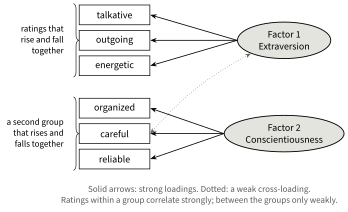
Factor analysis is a method that takes the correlations among many measured variables, such as self-ratings on trait adjectives, and finds a smaller number of underlying dimensions, called factors, that account for the pattern of correlations. The idea can be understood without the mathematics. Suppose that people who rate themselves as talkative also tend to rate themselves as outgoing and energetic, that people who rate themselves as organized also tend to rate themselves as careful and reliable, and that the first three ratings have little to do with the second three. Then two factors describe the six ratings almost as well as the six ratings describe themselves (Figure 1). The correlation between a rating and a factor is called the rating’s loading on that factor.
Figure 1. A factor analysis in one picture. Six self-ratings fall into two groups whose members correlate strongly with each other and weakly across groups, and the two groups are summarized by two factors, extraversion and conscientiousness. The pattern is the one Goldberg (1990) found for these adjectives; the arrows stand for the loadings, with a weak cross-loading drawn dotted.