

The Big Questions of Psychology
The closing unit of the Foundation masterclass turns the studies of Units 1 to 7 on the questions that made people study the mind in the first place. It works out what a heritability of 80% means and does not mean, explains one fear at four levels and asks which level is the real one, reads Libet's 1983 timeline and its critics, and revisits the replication crisis with the practices that caused it and the reforms that followed.
Seven units have taught methods, neurons, perception, learning, memory, thinking, and the behaviour of people in groups, and each of them has left a larger question standing in the background. How much of a person is inherited? Is a thought the same thing as the brain activity that accompanies it? Who decides when you lift a finger, you or your motor cortex? And can a science whose published findings replicated only about a third of the time in 2015 claim to be a science at all? This unit takes these questions one at a time, with the studies of the earlier units as its material, and says what psychology can answer, what it cannot, and where the honest answer is that nobody knows yet.
1 Nature and nurture
The phrase comes from Francis Galton (1822-1911), who put it in the title of his book English Men of Science: Their Nature and Nurture in 1874, and the question is older than the phrase. In its everyday form it is badly posed. Asking whether a person’s intelligence or shyness is due to genes or to upbringing is like asking whether the area of a rectangle is due to its length or to its width; without both there is no rectangle, and no person. The question that can be answered is about differences. In a given population, how much of the variation between people in a trait goes together with genetic differences between them, and how much with differences in their environments? Behavioural genetics is the part of psychology that answers this question, and it answers it by comparing relatives who share different amounts of their genes and of their surroundings.
1.1 Twins and adoptees
Two kinds of relatives make the design work, and Figure 1 shows them. Monozygotic twins, called identical twins in everyday speech, develop from one fertilized egg and share essentially all of their DNA. Dizygotic twins, or fraternal twins, develop from two eggs and share on average half of the genetic variants that differ between people, like any pair of siblings, but unlike ordinary siblings they share a womb, a birthday, and a childhood at the same time. If identical twins resemble each other in a trait more than fraternal twins do, and if both kinds of twins share their family environment to the same degree, then the extra resemblance of the identical twins must come from the extra genes they share. The second condition is called the equal environments assumption, and it is the point that critics of twin studies attack most, since identical twins are also dressed alike and treated alike more often than fraternal twins. The assumption has been tested in several ways, for example by comparing twins whose parents were mistaken about whether they were identical or fraternal (their zygosity, in the language of the field), and it holds well enough for most traits, but it is an assumption, and every heritability figure in this unit rests on it.
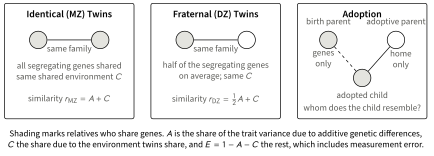
The adoption design separates the two influences more directly. An adopted child shares genes with the birth parents and a home with the adoptive parents, so the question of whom the child comes to resemble has a clean answer. The Colorado Adoption Project, begun by Robert Plomin and John DeFries in 1975, followed 245 adoptive families and 245 matched families raising their own children from the children’s first year into adulthood. For general cognitive ability, the broad intelligence that IQ tests measure, the result appeared slowly and then became clear. The correlation between the adopted children and their adoptive parents stayed near zero at every age, whereas the correlation with the birth mothers they had never lived with grew through childhood, until by the age of 16 the adopted children resembled their birth mothers about as much as the children in the control families resembled the parents who were raising them (Plomin et al. 1997). The rarest design, the study of twins who were reared apart, combines the two. The Minnesota Study of Twins Reared Apart assessed more than 100 pairs of twins who had been separated in infancy and raised in different families, and for the 48 identical pairs reared apart who took the Wechsler Adult Intelligence Scale the correlation was \(0.69\), against \(0.88\) for 40 identical pairs reared together (Bouchard et al. 1990). Twins who had never shared a home were almost as alike as twins who had shared everything.
1.2 Heritability
The number that comes out of these designs needs a precise definition, because almost everything that is said about it in public is wrong. The heritability of a trait, written \(h^2\), is the share of the variance of that trait in a given population, under the range of environments present in that population, that is associated with genetic differences between its members. It is a statistic about a population, of the same kind as the correlation coefficient of Unit 1, and four things follow from the definition.