Consciousness and the Brain
The closing unit asks how consciousness is measured when the only witness is the person who has it. It follows the methods that make a stimulus invisible, the signal detection logic that keeps a report honest, the states of sleep, anaesthesia, and brain injury, the patient who played tennis in a scanner, blindsight, neglect, and the split brain, the ignition signature, and the four theories, up to the preregistered adversarial test of 2025. It ends with how to read a research paper and where psychology is heading.
Every unit of this program has described something the brain does, and every one of them could have been written about a brain that experiences nothing. Fear conditioning, the forgetting curve, and the dopamine prediction error are accounts of information being processed, and none of them says why the processing is accompanied by anything at all, by the redness of red or the ache of a headache. This closing unit asks how consciousness is measured when the only witness is the person who has it, what sleep, anaesthesia, and brain injury switch off, which patients and brain signals have narrowed the search, and how the competing theories were put against each other in 2025. It ends with how to go on reading research alone.
1 What is to be explained
The word consciousness covers two things that are measured differently. A person’s state of consciousness is how awake and aware they are overall, from alert wakefulness through dreaming sleep to dreamless sleep, anaesthesia, and coma. The contents of consciousness are what the person is conscious of at a given moment, such as this sentence or the pressure of the chair. A state is judged from the whole person, whereas a content is judged from a comparison between what reached the senses and what the person noticed.
The philosopher Ned Block proposed in 1995 to separate two meanings of the word. Access consciousness is a content’s availability to the rest of the mind, so that it can be reported, reasoned about, and used to guide action. Phenomenal consciousness is the experience itself, the fact that there is, in Thomas Nagel’s phrase of 1974, “something it is like” to have the content, as there is something it is like to taste coffee and nothing it is like to be a stone. Nearly every experiment in this unit measures access, because the only way to know what someone is conscious of is to have them report it.
David Chalmers gave the deepest version of the problem its name in 1995. The easy problems are to explain the functions, such as how the brain discriminates stimuli and reports its states; the hard problem is to explain why the performance of these functions is accompanied by experience at all. Chalmers made his case with a thought experiment, the zombie, a being physically identical to a person that has no inner experience. If such a being is even conceivable, the physical facts would be the same with and without experience, so no account of the physical facts can by itself explain experience. Daniel Dennett and many others reply that a zombie is not really conceivable once the idea is thought through. This unit takes the view most researchers take in practice, which is that the easy problems are hard enough and that solving them well is the only route anyone has found towards the hard one.
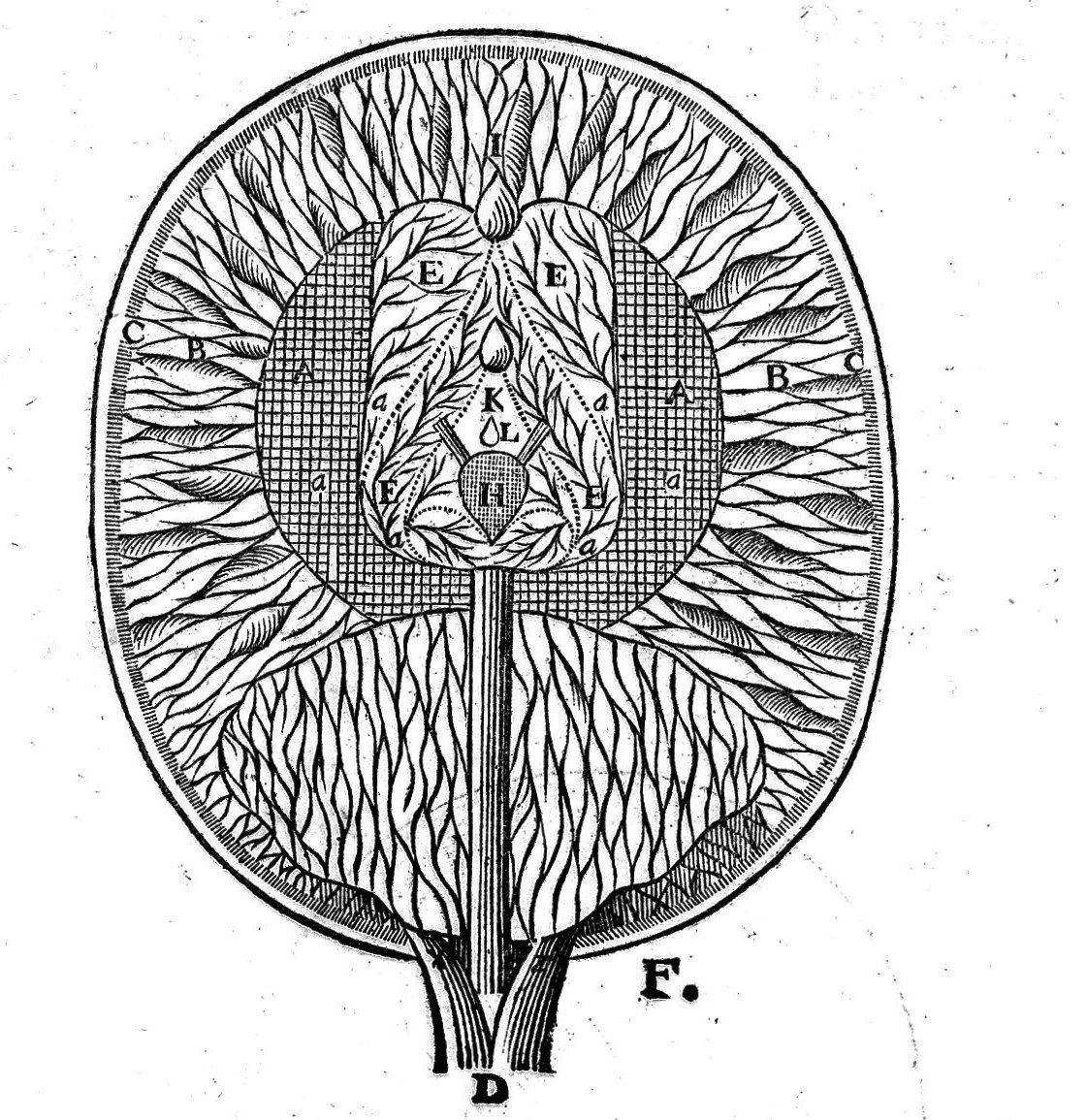
The practical programme of the field was set out by Francis Crick (1916-2004) and Christof Koch in 1990: rather than define consciousness first, look for the neural correlates of consciousness, the smallest set of events in the brain that together are enough to produce one specific experience, and postpone the question of why those events are accompanied by experience until the correlates are known. The idea that an experience has a place in the brain is much older than this programme. René Descartes (1596-1650) placed the meeting point of body and soul in the pineal gland (Figure 1), partly because it was the one structure of the brain he knew that was not doubled, and an experience seemed to him to be one undivided thing. The thought that this unity of experience must be reflected in the anatomy returns in Section 5.