 Image: Santiago Ramón y Cajal, Wellcome Collection, CC BY 4.0
How many neurons does the brain have
Ask anyone who has done a little biology how many neurons the human brain has and you will hear 100 billion, often with the addition that there are ten times as many glial cells. Both figures were in textbooks for forty years. Neither was ever measured. A review published in 2016 traced the 100 billion to the 1980s and found no study behind it; it was a round number that someone had written down and everyone had copied. The ten-to-one glia ratio had a similar history.
Why counting is hard
The obvious method is to cut thin slices of brain, count the cells in a small volume under a microscope, and multiply up. It is called stereology and it works well for a structure of uniform density. The brain is not one. The cerebral cortex has folds, the cerebellum has a layer of tiny cells packed a hundred times more densely than the cortex, and the density changes from region to region and within a region. Sampling a few sites and extrapolating to 1.4 kg gives an answer with an error nobody could estimate, and no laboratory had done it for a whole human brain.
The brain soup
In 2005 Suzana Herculano-Houzel and Roberto Lent in Rio de Janeiro published a method that goes round the problem. Take the tissue, fix it, and turn it into a uniform suspension in a detergent that dissolves the cell membranes but leaves the nuclei intact. Every cell has one nucleus, so counting nuclei in a measured sample of the suspension gives the number of cells in the tissue. Stain the sample with a dye for a protein found only in neuronal nuclei, and the fraction of stained nuclei gives the fraction of cells that are neurons. The method is called the isotropic fractionator, and it turns a problem of sampling a complicated structure into a problem of counting a well-mixed liquid, which is easy.
In 2009 Frederico Azevedo, Herculano-Houzel, and colleagues applied it to four whole human brains, from men aged 50 to 71 who had donated them. The result, published in the Journal of Comparative Neurology and at the journal, was 86 billion neurons, with an uncertainty of about 8 billion between brains, and 85 billion non-neuronal cells. The ratio of glia to neurons was about one to one. The 100 billion was out by 14%, which is not a large error for a number that had never been measured, and the ten-to-one ratio was simply wrong.
Where the neurons are
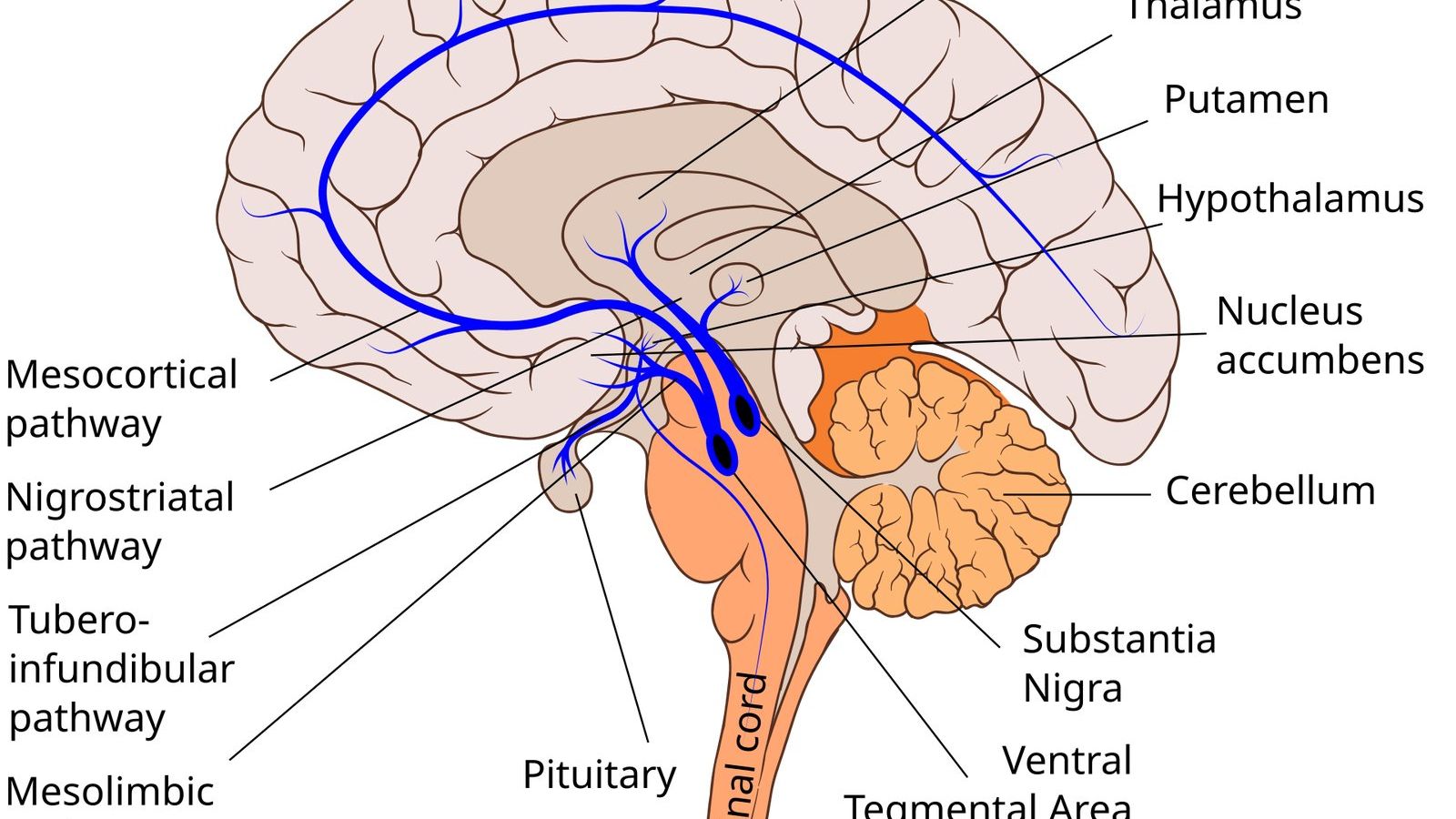
The distribution was the more surprising result. The cerebral cortex, the folded outer layer that does the thinking, holds about 16 billion neurons, which is 19% of the total, in 82% of the brain's mass. The cerebellum, the fist-sized structure at the back that coordinates movement, holds about 69 billion neurons, which is 80% of the total, in 10% of the mass. The rest of the brain, the brainstem, thalamus, basal ganglia, and everything else, holds under a billion.
Most of the cerebellar neurons are granule cells, among the smallest neurons in the body, and the count says nothing against the cortex; a cortical neuron with its long dendrites and thousands of synapses is a far larger and more connected thing than a granule cell. It does say that any statement about the brain's power that rests on the number of neurons is counting the wrong thing. What distinguishes the cortex is its wiring, and the number of synapses, somewhere between 100 and 500 trillion by estimates that are far less secure than the cell count, is the figure that matters more.
What the comparison with other animals showed
The same method applied to other species produced a second finding. Herculano-Houzel's 2009 paper in Frontiers in Human Neuroscience, "The human brain in numbers: a linearly scaled-up primate brain", free to read, showed that primate brains add neurons in proportion to their mass, while rodent brains add neurons more slowly as they grow, because rodent neurons get bigger with brain size and primate neurons do not. A rodent brain with 86 billion neurons would weigh about 35 kg. The human brain, on these numbers, is what a primate brain of its size is expected to be, with no special excess. The African elephant has three times as many neurons as we do, 257 billion, and 98% of them are in its cerebellum; its cortex has 5.6 billion, a third of ours.
The numbers also give the cost. A neuron uses energy at a roughly fixed rate, and the brain's consumption works out at about 6 kilocalories per billion neurons per day, which for 86 billion is about 500 kilocalories, a fifth to a quarter of what an adult at rest burns. Herculano-Houzel has argued that a primate the size of a human could not feed that many neurons on raw food in the hours of foraging a day allows, and that cooking, which makes food cheaper to digest, was the condition for a brain of this size. The argument is open, but the energy figures behind it are not.
Why the old number lasted so long
The lesson is partly about brains and partly about textbooks. A round number with no source survives because it is quoted rather than checked, and the more it is quoted the more it looks checked. The review that traced the history of the count, by Christopher von Bartheld, Jami Bahney, and Herculano-Houzel in 2016, is at the journal, and it is a good short lesson in how a field can carry a false figure for a generation. The masterclass states the measured number, 86 billion, in Unit 2, with the method and the uncertainty, and uses it again when the imaging units count how many of those neurons sit under a single voxel of an fMRI scan. The answer is about half a million, which is a number worth knowing before you read that a brain region lit up.