 Image: Edward H. Adelson, CC BY 3.0, via Wikimedia Commons
The dress, ten years later
The photograph was taken in a shop in Scotland in February 2015 by the mother of a bride, who wanted a second opinion on a dress for the wedding. The bride and her fiancé disagreed about the colours. The mother's friends disagreed. A member of the wedding band posted it online on 26 February with the question "guys please help me, is this dress white and gold, or blue and black?", and within a day it had been seen by tens of millions of people, who disagreed as well, loudly and with the conviction of people reporting what was in front of their eyes.
The dress itself was blue and black. That was never in doubt; the manufacturer confirmed it and the dress was photographed again under normal light. The question was why a single photograph, the same pixels on every screen, looked white and gold to a large minority and blue and black to the rest, and why neither group could see what the other saw. Vision scientists were as surprised as everyone else. Individual differences in colour perception had been thought small, and no known stimulus split the population like this.
The numbers
Within three months, three papers appeared in Current Biology. Rosa Lafer-Sousa, Katherine Hermann, and Bevil Conway surveyed 1,401 people. 57% saw the dress as blue and black, 30% as white and gold, about 11% as blue and brown, and a few as something else; the paper is free to read. Older people and women were more likely to see white and gold. When the same people were shown the photograph with the colours shifted, the disagreement vanished, which showed that there was nothing unusual about the observers' eyes. There was something unusual about the picture.
Karl Gegenfurtner, Marina Bloj, and Matteo Toscani measured what. The pixels of the dress, plotted in colour space, lie almost exactly along the daylight locus, the line of colours that natural light takes from the blue of a shadowed sky to the yellow of direct sun. The paper is at the journal. That is the one line along which the visual system is most practised at discounting the light, and the photograph, overexposed and with no clear source of illumination in view, gave it nothing to go on.
Colour constancy
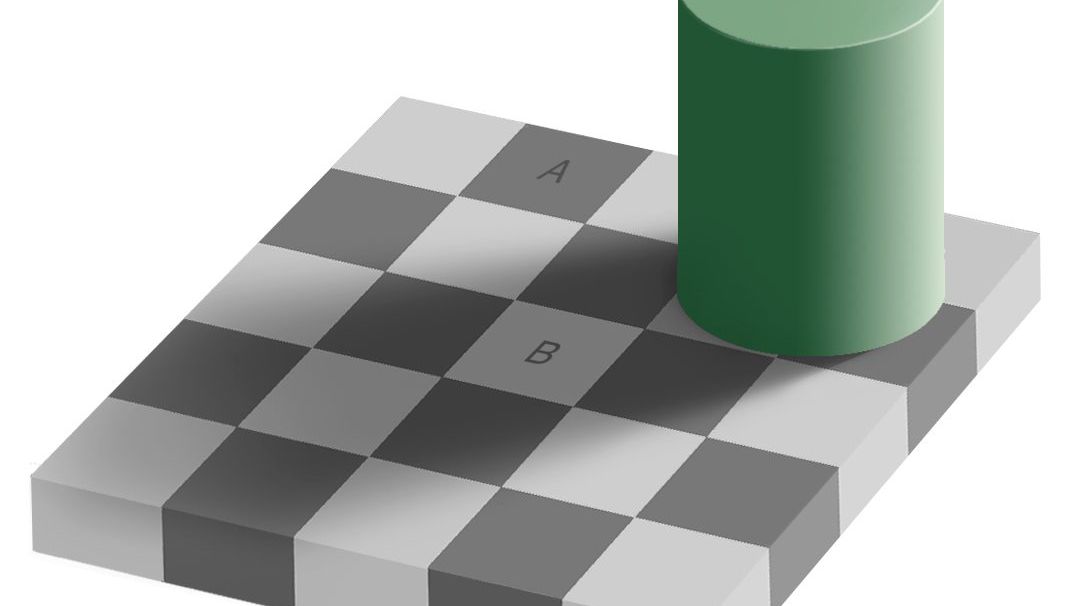
The colour of the light that reaches your eye from an object is the product of the object's surface and the illumination falling on it. A white sheet of paper under the blue light of a shadow sends bluish light to the eye; under a yellow lamp it sends yellowish light. You see white paper in both cases, because the visual system estimates the illumination from the whole scene and discounts it. The ability is called colour constancy, it is present in infants, and it is the reason the colour of things does not change as you walk from indoors to outdoors. The checker-shadow illusion shows the same process for brightness, and Unit 3 of the masterclass uses both.
The dress photograph defeats the estimate. The light source is behind and above the dress, out of frame, and the exposure has washed out the cues. A viewer whose visual system assumes that the dress is in bluish shadow discounts the blue and sees the fabric as white, and the black trim, lit by the same assumed light, comes out gold. A viewer who assumes that the dress is under warm artificial light discounts the yellow and sees blue fabric and black trim. The pixels are the same. The assumption about the light is different, and the assumption is not something the viewer can inspect or change by trying.
Who assumes which light
The question left open in 2015 was why a given person makes a given assumption. Pascal Wallisch, at New York University, collected responses from about 13,000 people together with questions about their habits, and reported the analysis in the Journal of Vision in 2017; the paper is free to read. The variable that predicted the colours best, after controlling for age and sex, was whether people described themselves as early risers or night owls. Larks, who spend more of their waking hours in daylight, were more likely to see white and gold; owls, who spend more time under artificial light, were more likely to see blue and black. People who said they assumed the dress was in shadow saw white and gold; people who assumed artificial light saw blue and black.
The interpretation is that the visual system's prior about illumination is learnt from the light each person has spent their life under. It is not a large effect, and it does not explain everyone, but it is the kind of result that turns a curiosity into a finding: a difference in perception that follows from a difference in experience, in the direction the theory predicts. Later work found that the same people are consistent over years, that the split exists in other languages and countries, and that a few other photographs, found by searching for the same lighting ambiguity, produce weaker versions of the same disagreement.
What it taught
Three things, each of which was known to vision scientists and none of which had ever been demonstrated to a hundred million people at once.
First, perception is an inference. What you see is the brain's best estimate of the surfaces out there, given the light that arrived and an assumption about where it came from. Usually the assumption is right and the estimate is excellent, which is why it feels like direct contact with the world. The dress is a case where the assumption is forced to vary, and the estimate varies with it.
Second, the inference is private and unarguable. Nobody who saw white and gold could be talked into seeing blue and black, because there was no seeing of pixels underneath that could be corrected; the inference was the seeing. The disputes of February 2015 were, in miniature, the problem of every eyewitness and every argument about what was plainly there.
Third, individual differences in perception are larger than the textbooks had said. Ten years later, the dress is a standard stimulus in laboratories, a chapter in perception courses, and the research spotlight of the masterclass unit on perception, where Wallisch's paper is read in full. A wedding dress from a shop in Scotland became the clearest piece of evidence in the field for the claim that seeing is a conclusion rather than a copy.